How to write meaningful next steps in the EYFS
What a next step really is, when it is worth recording one, and how to make it specific and useful — with before-and-after examples and what Development Matters actually says.
5 min read
Ask ten practitioners what a "next step" is and you will get ten answers — and a fair few weary sighs, because for many settings next steps have become the most time-consuming and least useful part of the paperwork. This guide is about reclaiming them: what a next step actually is, when it is worth writing one down, and how to make the ones you do write genuinely useful.
First, what a next step really is
A next step is your planned response to what you have noticed — what you will offer, say, or set up to help a child build on where they are now. That is all.
It is not a target the child has to hit, and it is not a box that every observation has to fill. Crucially, a next step is far more often something you do than something you write — a question you ask in the moment, a resource you add to the provision, a conversation you have tomorrow.
What Development Matters actually says
This matters because a lot of settings write far more next steps than the guidance ever intended. Development Matters is unusually direct about it:
You can use your professional knowledge to help children make progress without needing to record lots of next steps.
And on assessment more broadly:
Assessment is about noticing what children can do and what they know. It is not about lots of data and evidence.
Read together, the message is clear: knowing your children well matters more than documenting a next step for each of them. A next step is worth recording when writing it down genuinely helps you — or a colleague — plan. Not to satisfy a template.
When a next step is worth writing down
Record one when it does real work:
- when it will shape what you provide next week and you might otherwise forget;
- when a colleague or a child's key person needs to act on it too;
- when it captures something specific you have decided to do for this child.
If none of those apply, the "next step" is probably better lived than logged.
What makes a next step meaningful
When you do write one, four things separate a useful next step from filler.
It is specific. "Continue to support Aria's maths" tells no one anything. Name the actual thing you will do.
It follows from what you saw. A next step should grow out of the observation in front of you — not from the topic plan, and not from the next statement in a list. Development Matters warns against exactly this: "depth in learning matters much more than moving from one band to the next".
It is achievable and small. Something you could genuinely set up this week, not an aspiration for the term.
It belongs to the child, not the paperwork. It reflects what this child needs next, which is why identical next steps copied across a group are a warning sign.
Before and after
The difference is easiest to see in pairs. Each of these follows the same observation.
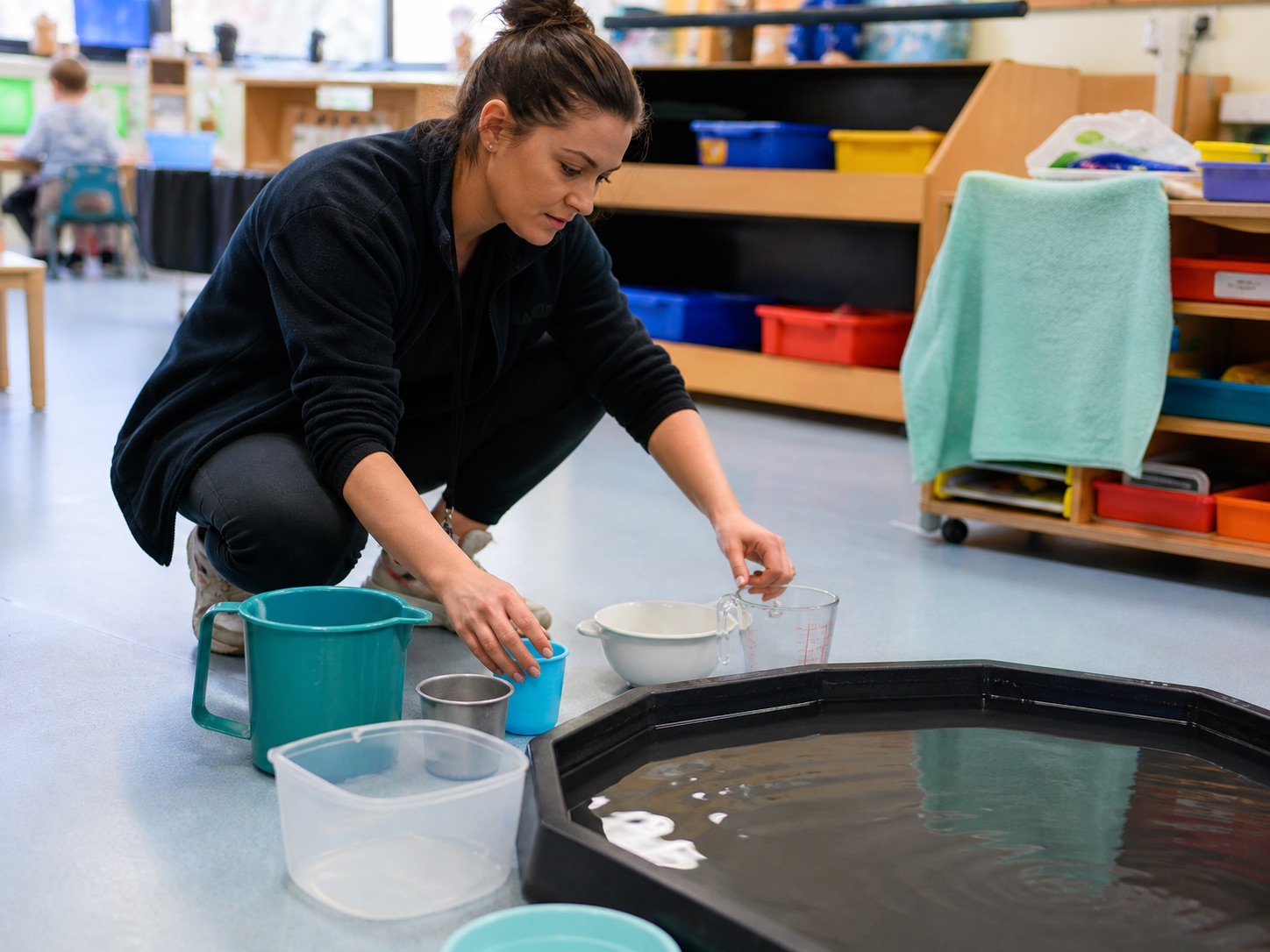
Water play — comparing capacity
Weak: Continue to develop Priya's mathematical development and provide more maths activities.
Vague, generic, and interchangeable with any child. It names an area, not an action, and gives nobody anything to do.
Strong: Add tall, narrow and short, wide containers to the water tray this week and model "holds more" and "holds less" as she pours, to build on the comparing she started today.
Specific, achievable, and tied directly to what Priya actually did.
Mark-making — early writing
Weak: Next step: work on Sam's fine motor skills and pencil grip.
A deficit framed as a task, with no plan behind it.
Strong: Put the dough gym and the tweezers-and-pompoms tray out alongside the mark-making this week, and offer chunky chalks outdoors, so Sam keeps strengthening the grip he is already using with real purpose.
Same intention, but now it is something you can actually do — and it builds on a strength rather than chasing a deficit.
Role play — negotiating with others
Weak: Encourage Ava to share more and play nicely with her friends.
An adult value ("nicely") dressed up as a plan.
Strong: Introduce a shared "café" role-play with a limited number of cups and saucers, so there is a real reason to take turns, and be nearby to name it when Ava negotiates a solution herself.
The strong version sets up the conditions for the learning to happen, rather than just wishing for it.
The patterns to avoid
- The "continue to…" next step. "Continue to support / develop / encourage…" is almost always filler. It commits you to nothing.
- The copy-paste. The same next step across a whole group means it is about the paperwork, not the children.
- The deficit target. "Can't yet do X, so next step is X." Build on what a child is doing, not only on what they are not.
- The adult task in disguise. "Observe Sam again next week" is something you will do, not a step in the child's learning.
- The everything-everywhere. A next step for every observation, every day, for every child. This is precisely the "lots of data" Development Matters tells you to stop generating.
In the moment vs written down
The most powerful next steps rarely reach a page at all. A well-timed question — "I wonder what would happen if…" — or an extra resource slipped into the provision moves learning on immediately. Trust those. Reserve the written next step for when recording it genuinely earns its place.
Where this fits
A next step is the final part of the observe-assess-plan cycle. If the earlier parts are shaky, no next step can rescue them — so it is worth getting the whole observation right first. See our guides on how to write an observation and what makes a good one, and, for how the framework underpins all of it, what Development Matters is.
Quotations are from Development Matters (Department for Education, updated 4 September 2023), Open Government Licence v3.0.