Good vs weak observations: what makes the difference
What separates an observation you can act on from one that wastes everyone's time — with four worked before-and-after examples across the areas of learning.
8 min read
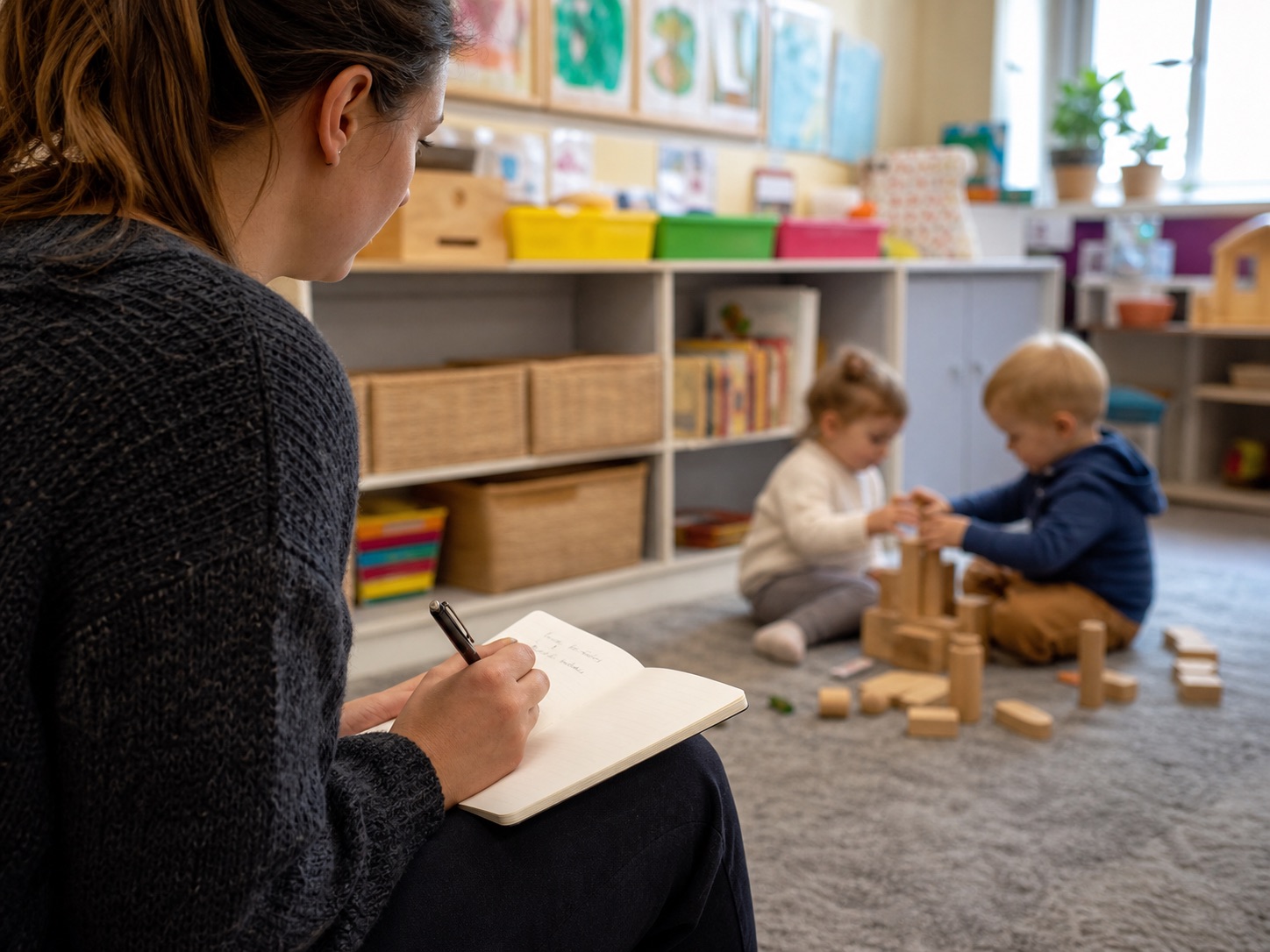
Every practitioner writes observations. Far fewer are taught what actually makes one good — so the difference between an observation that moves a child's learning forward and one that just fills a record often comes down to habit rather than judgement.
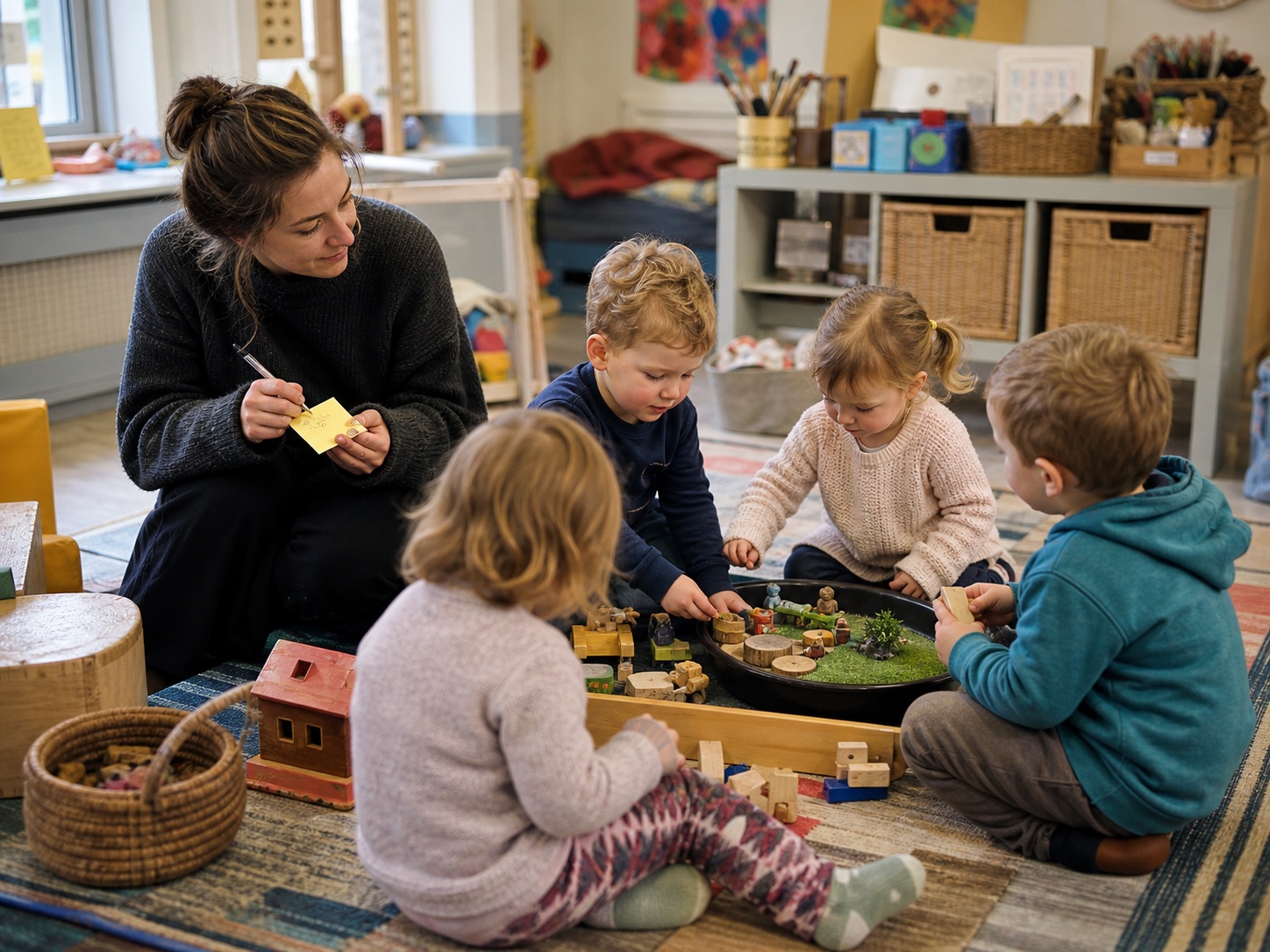
It is worth getting right, because an observation is not paperwork for its own sake. It is the raw material for three things that matter: assessment (what does this child understand?), planning (what should we offer next?), and the conversations you have with parents and colleagues. A weak observation starves all three. A strong one feeds them in a couple of sentences.
This guide sets out what "good" looks like, then shows the difference in action with four before-and-after examples.
First, what an observation is for
The Early Years Foundation Stage describes an ongoing cycle: you observe, you assess what the observation tells you, and you plan what to do next — then you observe again. Development Matters, the Department for Education's non-statutory guidance, is explicit that assessment should not "entail prolonged breaks from interaction with children, nor require excessive paperwork".
That single line is the test for everything below. A good observation earns its place in that cycle. If it does not help you understand the child or decide what to do next, it is not a good observation — however neatly it is written.
The anatomy of a strong observation
Strong observations share the same handful of qualities. None of them is about length or polish.
It is specific and objective. It records what the child actually did and said, in enough detail that a colleague who wasn't there can picture it. It describes behaviour, not the adult's opinion of the behaviour.
It is about the child, not the activity. "We made playdough today" is a plan. What this child did with the playdough is an observation.
It reveals thinking. The best observations capture a moment where you can see the child working something out — solving a problem, testing an idea, managing a feeling — not just completing a task.
Its framework link is justified. A link to an area of learning is only meaningful if the child's own words or actions support it. If you cannot point to the evidence, do not make the link.
It leads to a purposeful next step. The next step should follow from what you saw, be small enough to set up tomorrow, and be specific to this child — not lifted from a topic plan.
It is proportionate and prompt. It is as long as it needs to be, no longer, and written while the detail is still fresh.
Four examples, weak and strong
Here is what those qualities look like in practice. Each pair describes the same moment, written badly and then well.
1. Physical development — at the climbing frame
Weak: Tom had lots of fun on the climbing frame today with his friends. He was really active and loved being outside. Great gross motor skills!
The problem is that almost none of this is observation. "Lots of fun", "really active" and "great gross motor skills!" are the adult's verdict, not the child's behaviour, and the exclamation mark is doing the assessment. A colleague reading it learns nothing they could act on, and the skills claim has no evidence behind it.
Strong: At the climbing frame Tom climbed to the third rung, paused, and looked down to see where to place his foot before stepping across to the platform. When another child wanted to pass, he shifted his grip and pressed himself against the frame to make room, then carried on.
Link: Physical development — negotiating space and obstacles safely, shown by "pressed himself against the frame to make room".
Next step: Set out a low balance beam leading to the A-frame, to extend how he plans and adjusts his movements over changing surfaces.
Now the reader can picture it, the skill is demonstrated rather than asserted, the link quotes its own evidence, and the next step builds directly on what he did.
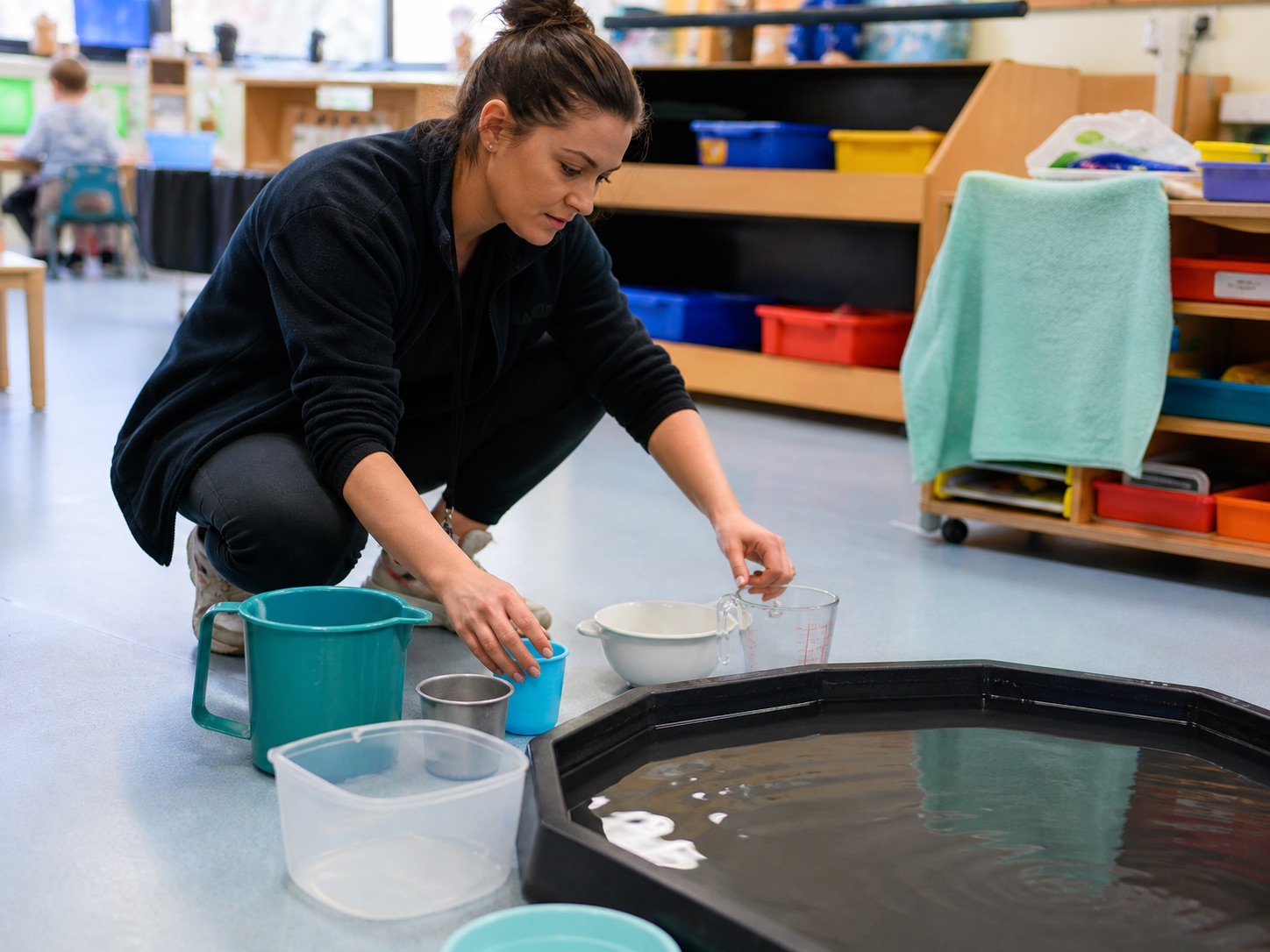
2. Mathematics — at the water tray
Weak: Priya played at the water tray. She was pouring water and filling up the cups. She likes water play.
This is an activity report. It records what was on offer, not what Priya understood, and "she likes water play" is a preference, not learning. There is nothing here to assess and nowhere to go next.
Strong: Priya filled a small cup, poured it into a tall jug, and said "need more" before filling and pouring twice more until the jug was full. She then held the empty cup against the full jug and said "that one big".
Link: Mathematics — comparing capacity and using the language of quantity, shown by "need more" and "that one big".
Next step: Offer containers of obviously different sizes and model "full", "empty" and "holds more" alongside her as she pours.
The strong version captures a genuine mathematical moment — she noticed the jug held more than the cup — and her own words carry the evidence.
3. Personal, social and emotional development — a dispute over a toy
Weak: Sam is very kind and gets on well with everyone. He shared the cars nicely and was a good friend today.
This could be written about almost any child on almost any day. "Kind", "nicely" and "good friend" are the adult's values projected onto the child, with no incident behind them. Global personality statements like this feel positive but tell you nothing.
Strong: When Ava took the red car Sam had been lining up, Sam frowned and said "that's mine". He glanced towards a practitioner, took a breath, and then told Ava, "you can have it after me." He waited with his hand out and took it back when she had finished.
Link: Personal, social and emotional development — beginning to manage a conflict and negotiate a solution with growing independence, shown by "you can have it after me".
Next step: When this happens again, name the strategy out loud — "you found a way to take turns" — to help him recognise and repeat it.
The strong version shows self-regulation actually developing, in a specific moment, with a next step that reinforces it.
4. Expressive arts and design — at the easel
Weak: Maya did some lovely painting at the easel. She used lots of colours and was very creative.
"Lovely" and "very creative" are compliments, not observations, and "lots of colours" tells you nothing about what she was thinking.
Strong: Maya brushed blue over yellow, stopped, pointed at the patch and said "green!". She dipped the brush again, made a second patch beside it, and looked between the two as if checking they matched.
Link: Expressive arts and design — exploring what happens when colours are mixed; and Communication and language, naming what she noticed.
Next step: Offer only the primary colours again with a small mixing tray, so she can predict and test more combinations.
A single moment of discovery, captured with her own reaction as the evidence, is worth more than a paragraph of praise.
The weak patterns, named
Most weak observations fall into a handful of recognisable traps. Learning to spot them in your own writing is the fastest way to improve.
- The activity report. "We did X today." Describes the provision, not the child.
- The judgement without evidence. "Is very confident / kind / creative." A verdict with nothing behind it, and usually interchangeable between children.
- Framework-stuffing. Padding a thin note so it can reach for statements it doesn't really support. A short, honest observation always beats this.
- The milestone tick. "Can hold a paintbrush." Records that something happened but captures no learning and suggests no next step.
- The novel. So long that the one moment that mattered is buried. Length is not the same as substance.
- The vague. "Had fun", "engaged well", "played nicely." Pleasant, and empty.
A quick self-check
Before you file an observation, read it back against these:
- Could a colleague who wasn't there picture what happened?
- Have I recorded what the child did, not what I thought of it?
- Can I point to the words or actions that justify each framework link?
- Does the next step follow from this moment, and could I set it up tomorrow?
- Is it as short as it can be while still being clear?
If it passes all five, it is a good observation — regardless of how long it is.
Quality over quantity
The settings that assess well are rarely the ones writing the most. They are the ones writing observations that are specific, honest and genuinely useful — and writing fewer of them, because each one does its job.
That discipline is exactly what makes the writing-up feel like a burden: doing it properly takes time and attention, moment after moment, all week. It is the part Obsly was built to take on — turning your note into a written observation with framework links that quote your own words, so the evidence is always there and the link is always earned.