The seven areas of learning in the EYFS explained
The three prime and four specific areas of learning, why the distinction matters, and what each area actually covers in everyday practice.
3 min read
The EYFS organises children's learning into seven areas of learning. They are the backbone of both the statutory framework and of Development Matters, and knowing what each one actually covers is what lets you see the learning in an ordinary moment of play.
This guide explains the seven areas, why they are split into "prime" and "specific", and what each looks like day to day.
Prime and specific: why the split matters
The seven areas are not all equal, and they are not meant to be. Three are prime areas and four are specific areas.
The prime areas come first because they are the foundations everything else is built on, and they develop fastest in the earliest years:
- Communication and language
- Personal, social and emotional development
- Physical development
The specific areas grow out of the primes and become more prominent as children get older:
- Literacy
- Mathematics
- Understanding the world
- Expressive arts and design
The practical consequence: for the youngest children, and for any child who needs it, the prime areas take priority. A child who is struggling to communicate or to feel secure will find the specific areas hard going until those foundations are stronger.
The prime areas
Communication and language
The development of listening, attention, understanding and speaking. It is arguably the single most important area, because so much other learning depends on it — and it grows through the quantity and quality of everyday talk more than through any planned activity.
Personal, social and emotional development
How children build relationships, develop a sense of self and self-worth, express and manage their feelings, and grow in confidence and independence. Secure, respectful relationships are the foundation, and this area underpins a child's ability to learn at all.
Physical development
Both gross-motor skills (moving, balancing, climbing, coordination) and fine-motor skills (grasping, using tools, and eventually handwriting), along with growing independence in self-care and an understanding of healthy habits. Physical confidence supports concentration and wellbeing across everything else.
The specific areas
Literacy
Early reading and writing, built on a foundation of spoken language. It spans enjoying and understanding stories, developing phonological awareness, learning that print carries meaning, and — later — blending sounds to read and composing their own writing.
Mathematics
A confident, positive relationship with number and pattern: counting, subitising, comparing quantities, and exploring shape, space and measure. The emphasis is on deep understanding of a few key ideas, not racing through content.
Understanding the world
Making sense of the physical and social world — people, communities and cultures; living things and the natural environment; and a growing sense of past and present. It is built on rich first-hand experiences and the vocabulary that goes with them.
Expressive arts and design
Exploring and using a range of media and materials — art, music, movement, dance, role play and design — and the imagination and creativity that run through them. It is as much about the exploring and thinking as about any finished product.
How the areas work together
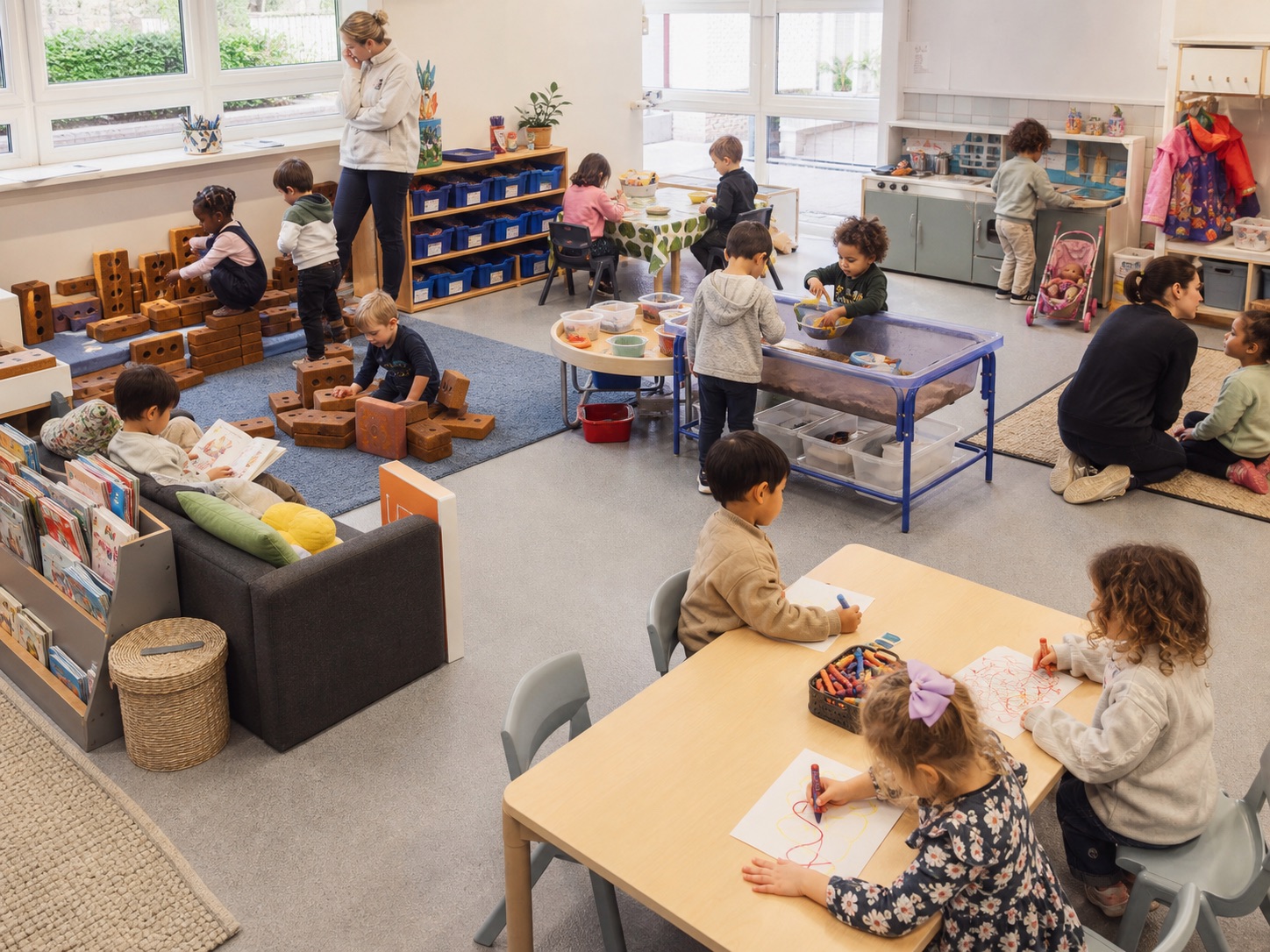
In practice, a single moment of play almost never sits in one area. A child running a pretend café is using communication and language, personal and social skills, mathematics (counting cups, taking orders), and expressive arts all at once. That is why the areas are a lens for noticing learning, not a set of boxes to sort activities into — and why a good observation often links to more than one.
The areas also develop differently at each stage. For what they look like across childhood, see our guides to the three Development Matters phases: birth to three, three and four-year-olds, and children in reception.
For the bigger picture, see what Development Matters is and the Characteristics of Effective Teaching and Learning, which describe how children learn across all seven areas.
This guide draws on Development Matters (Department for Education, updated 4 September 2023), Open Government Licence v3.0.