Children in reception: development and the Early Learning Goals
How children develop in reception across the seven areas of learning, how this phase leads to the Early Learning Goals and the EYFS Profile, and how to support the year.
3 min read
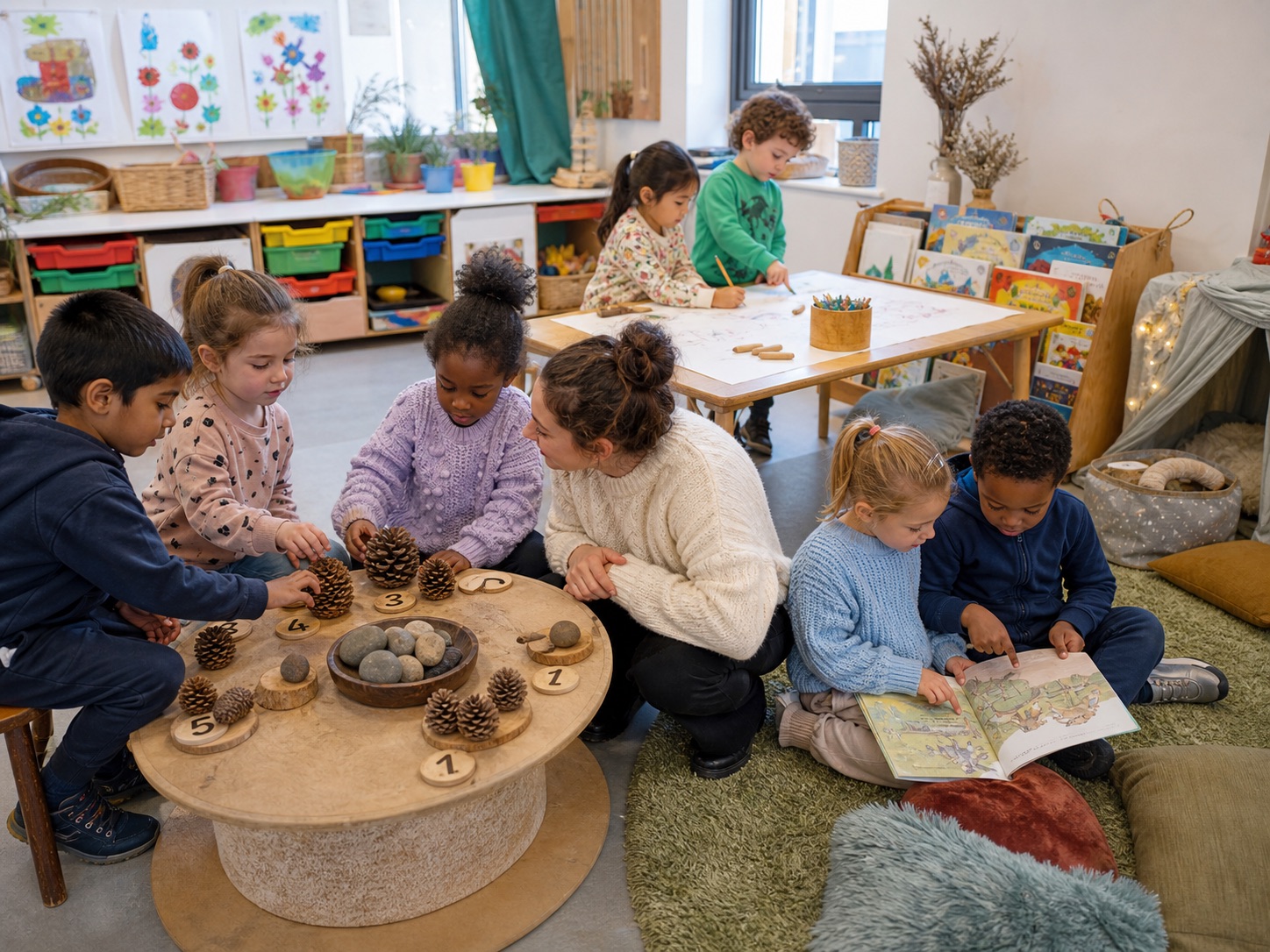
The third and final Development Matters phase is "Children in reception" — the year in which everything from the earlier phases is drawn together towards the Early Learning Goals (ELGs), assessed at the end of the year. It is a distinctive phase, and the framework treats it differently from the two before it.
What makes reception different
The birth-to-three and three-and-four phases carry observation checkpoints along the way. The reception section does not. Instead, it points towards the end-of-year expectations described by the Early Learning Goals, and to the EYFS Profile — the statutory summative assessment made in the final term of reception.
That does not mean reception is about tracking children against the goals all year. Development Matters is explicit that its guidance "guides, but does not replace, professional judgement." The ELGs describe where the year is heading; they are not a curriculum to be taught line by line, nor a checklist to assess against every week.
Development across the seven areas
The prime areas
- Communication and language: listening carefully, learning and using new vocabulary, asking questions, articulating ideas in full sentences, and engaging with stories, rhymes and non-fiction.
- Personal, social and emotional development: a growing sense of self-worth, building respectful relationships, expressing and managing feelings, showing resilience, and understanding the basics of health and wellbeing.
- Physical development: refining fundamental movement skills, developing strength and coordination, mastering the fine-motor control needed for writing and tools, and managing daily routines independently.
The specific areas
- Literacy: blending sounds to read words, reading with growing accuracy, understanding what has been read, and combining handwriting with composing their own writing.
- Mathematics: subitising, counting reliably, exploring number patterns and relationships, and beginning to reason about shape and space.
- Understanding the world: investigating living things and environments, and learning about communities, cultures and the world beyond their own experience.
- Expressive arts and design: exploring a range of creative media, imaginative and role play, and developing their own artistic expression.
The Early Learning Goals and the EYFS Profile
At the end of reception, teachers complete the EYFS Profile: for each child, a judgement of whether they are meeting the expected level described by each Early Learning Goal, or not yet reaching it (described as "emerging"). This is a summative picture, based on the teacher's ongoing knowledge of the child, and it is shared with parents and with the child's Year 1 teacher to support transition.
Crucially, the Profile is a professional judgement drawn from knowing the child well — not the product of piles of collected evidence. The same principle that runs through the whole framework applies: assessment "is not about lots of data and evidence."
How to support the reception year
- Keep talk rich and vocabulary explicit — reception children learn an enormous number of new words.
- Make early reading and maths playful and purposeful, rooted in real contexts rather than worksheets.
- Offer genuine problems to solve and sustained projects that let children concentrate and plan.
- Give transition — both into reception and on to Year 1 — the attention it deserves.
When to seek extra support
If a child is finding a particular area persistently difficult, or you have a concern about their communication, movement, or social and emotional development, raise it early rather than waiting for the end-of-year Profile. Your setting's SENCO is the first port of call, alongside the family. Early, specific support is almost always more effective than a label at the end of the year.
Where this fits
Reception is the last of the three Development Matters phases, following birth to three and three and four-year-olds. For the wider picture see our child development overview and what Development Matters is.
This guide is general information, not a diagnostic tool. Quotations are from Development Matters (Department for Education, updated 4 September 2023), Open Government Licence v3.0. For any concern about an individual child, seek advice from a qualified professional.